
Porcelain Slabs: The Complete Guide to Large Format Tiles

Black and gold bookmatched porcelain slabs on a living room feature wall behind a cream sofa.
Peter Yusuf

Porcelain slabs are large-format porcelain tiles designed to create a spacious look with fewer grout joints. Available dimensions vary by product and manufacturer. The thickness depends on the product, application and installation method. Please check the manufacturer’s specifications before selecting slabs for walls, floors, benchtops or outdoor areas. You can contact Royal Tiles for more information about porcelain slabs that we supply. 

Porcelain has a water absorption rate of 0.5% or less, which means it holds up well in bathrooms, kitchens and feature wall applications without periodic sealing.

Royal Tiles stocks the porcelain slabs range at 255 Parramatta Road, Auburn and at the Lidcombe showroom in NSW.

What Are Porcelain Slabs?

You’ve probably seen them without knowing what they were called. The bathroom in a hotel, a friend’s new apartment, a renovation you saw on Instagram. No grout grid, just one continuous surface running wall to wall. That’s a porcelain slab.

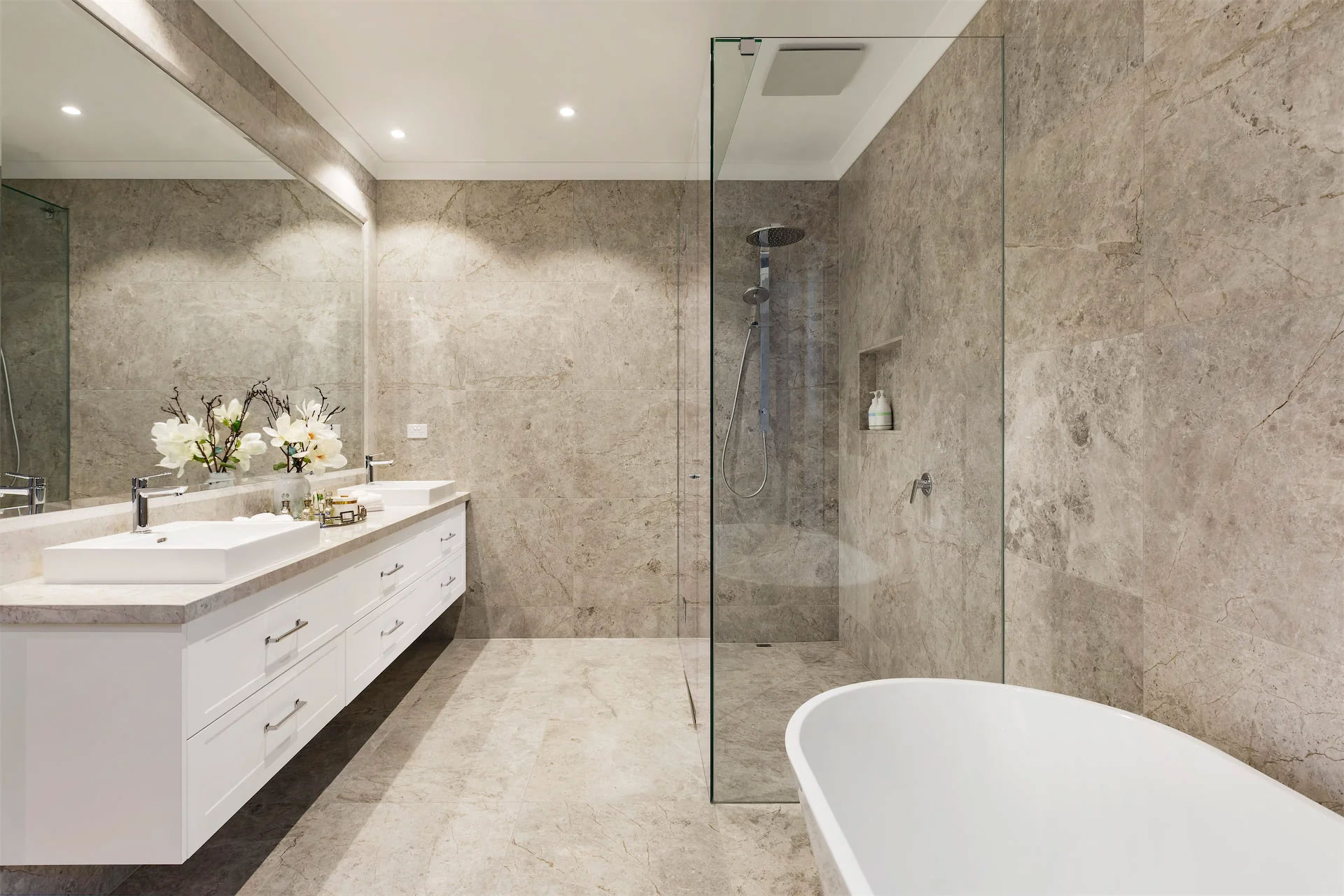
What people notice first about a slab-tiled bathroom is what is missing. No grid of grout lines dividing the surface into smaller pieces. The stone pattern keeps going the way it would if the material really were stone. A 1200 × 2400 mm slab covers the area that eight 600 × 600 mm tiles would cover and that difference in joint count matters when you’re cleaning a bathroom every week.

For wet areas, select a porcelain slab approved for the application and follow the specified waterproofing and installation requirements.

Porcelain Slab Sizes and Thickness Explained

Start with the intended application, then consider size, thickness and finish.

Thin slabs work well on bathroom walls and kitchen splashbacks. For benchtops, please check thickness and backing requirements with us before you order, it varies by product.

Floors and outdoor terraces need a bit more attention, with slip rating, thickness and what’s going underneath all come into it. Our team can help you work through the options.

On size, going to 1200 × 2400 mm or larger across a bathroom wall cuts grout joints significantly compared to standard-format tiling over the same area. Fewer joints means less to clean and less visible grout over the life of the installation. The Royal Tiles large format porcelain tiles guide goes into the detail on which formats work best in which rooms.

Porcelain Slabs vs Natural Stone Slabs

Natural stone has something porcelain can’t fully match when you’re standing close to it. The individual variation between pieces, the depth in a honed finish, the way light sits differently on real marble. Customers who know stone well can usually tell. If that quality is part of what you’re paying for, natural stone is worth the cost.

For customers choosing between porcelain stone slabs and genuine natural stone, it usually comes down to how much maintenance you’re willing to sign up for versus how much the authentic character of the real material matters. Porcelain’s low-porosity surface resists penetration from cooking acids and everyday cleaning products more effectively than unsealed polished natural stone and it costs less to maintain over time. Natural stone starts at a higher per-square-metre price and maintenance costs add to that over the years. The Royal Tiles natural stone vs porcelain tiles guide covers this properly for Sydney conditions. 

The marble vs natural stone tiles guide and the travertine vs travertine-look porcelain guide go deeper on specific material comparisons.

Marble-Look and Stone-Look Porcelain Slabs

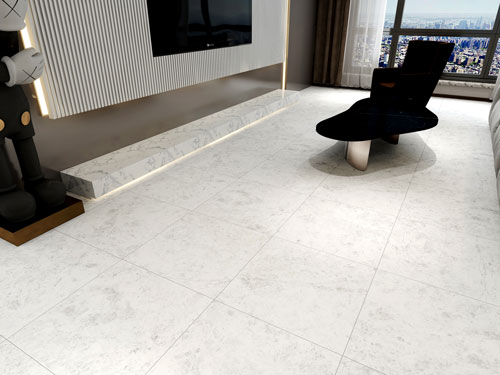
The marble look porcelain slab is what drives most slab conversations at the Royal Tiles showroom right now. At slab scale the stone patterns do something a standard tile can’t.

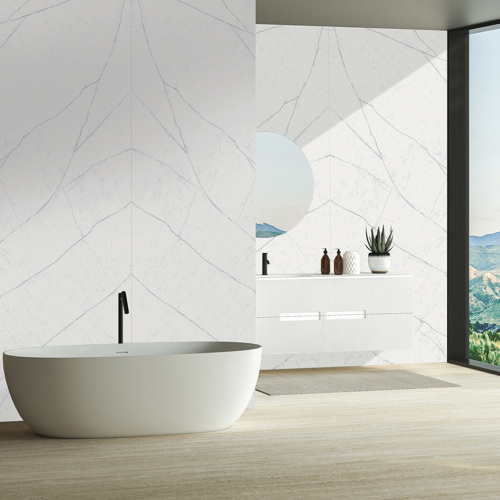
Super White offers a white marble-look finish. White ground with soft grey veining at Calacatta or Statuario scale and without grout lines cutting across the surface, the veining runs the way it does in real stone. We advise on using Super White for feature bathroom walls, kitchen splashbacks and full-height porcelain wall cladding where the marble look is the starting point. Pair it with brushed brass tapware and white joinery in a kitchen, or warm timber cabinetry in a bathroom. 

Amber is for warm palettes. Honey and caramel tones with organic movement that suits kitchen benchtop surfaces and living areas feature walls where the brief is warmth rather than the cooler end of the marble spectrum.

Gemstone is for when the slab needs to carry the room. Deeper tonal movement that works in commercial lobbies, resort bathrooms and residential feature walls where a quieter finish would underdeliver. Go for Gemstone with matte black hardware and concrete flooring for something strong and contemporary, or layer it with natural stone and timber for a richer result.

The Royal Tiles Italian tiles guide covers the manufacturing tradition behind large-format slab design.

Magazine and flower pot on white penny round mosaic tile floor Magazine and flower pot on white penny round mosaic tile floor mobile version

Slash prices, not your budget!

Enjoy savings of up to
50% on all the clearance items.

Where to Use Porcelain Slabs: Walls, Floors and Benchtops

Bathroom walls

For a bright, marble-look bathroom, consider Super White porcelain slabs for wall cladding. The large format reduces grout joints and creates a more continuous appearance and allows the veining to stand out. For a coordinated floor-to-ceiling look, pair Super White walls with complementary warm grey or cream large-format floor tiles.

Tass Prassas, who sourced tiles for bathrooms and kitchen through Royal Tiles, described the experience:

We just bought tiles for our bathrooms and kitchen. Ruben was fantastic and we would recommend him to everyone. He was very helpful.

Tass Prassas

Tass Prassas

  • ★
  • ★
  • ★
  • ★
  • ★

Kitchen benchtops and splashbacks

The low-porosity surface of 6mm porcelain slabs resists penetration from cooking oils, food acids and everyday cleaning products. The tile surface itself requires no periodic sealing to maintain that resistance, which is one less thing to think about in a kitchen that gets used properly.

A matching benchtop and splashback in the same slab finish reads as one surface from bench height to the upper cabinet line. Super White works in white kitchen contexts and Amber suits warm or dark joinery.

Feature walls and floors

Large porcelain slabs suit living area feature walls, luxury apartment lobby floors and resort bathrooms where a continuous slab surface at scale is part of the brief.

If you’re comparing porcelain slabs against other premium paving formats, the porcelain pavers vs travertine vs concrete pavers guide has the detail you need.

How to Buy Porcelain Slabs in Sydney

Slab orders work differently from standard tile stock. Sheets at 1200x2400mm and above need specific transport and handling and some finishes need to be ordered ahead of the project start date. Confirm the lead time before locking in the project timeline, because slabs on back-order have held up more than a few Sydney renovations. The Royal Tiles FAQ page covers common product selection questions.

Royal Tiles stocks porcelain slabs in Sydney at 255 Parramatta Road, Auburn, around 25 to 35 minutes from the Sydney CBD, with a second showroom now open in Lidcombe serving Western Sydney. If you want to buy porcelain slabs for a project in Parramatta, the Eastern Suburbs, the Hills District or anywhere across NSW, seeing slab finishes at full scale in person changes the decision in a way no product photo can.

Three ways to get started:


Browse the Royal Tiles porcelain slabs range to see all marble-look and stone-look finishes currently stocked.

Visit the Auburn showroom or Lidcombe showroom to see slab samples at full scale before ordering.

Book your free design consultation and bring your floor plan or project brief. Our team can advise on thickness, finish, size and which products suit your specific application.

Frequently Asked Questions

What are porcelain slabs?

Your bathroom has almost no grout lines and the stone pattern runs uninterrupted from one edge of the wall to the other. That is what porcelain slabs look like. A single slab sheet covers the area that multiple rows of standard-format tiles would cover, and that's where the reduction in grout lines comes from.

What thickness do porcelain slabs come in?

Porcelain slabs are available in different thicknesses depending on the product and manufacturer. The correct choice depends on what you are using them for: walls, floors, benchtops or outdoor areas. Contact Royal Tiles to confirm the available thicknesses and suitability of the slabs we supply for your project.

Are porcelain slabs better than natural stone?

Natural stone has something porcelain can't fully match when you're up close to it. If that's part of what you're buying, get the real thing. For most Sydney projects, porcelain is the more practical answer: the tile surface requires no periodic sealing, resists penetration from common cooking acids more effectively than unsealed polished natural stone and costs less to maintain over the life of the installation. The Royal Tiles natural stone vs porcelain tiles guide covers the full comparison.

Can porcelain slabs be used for kitchen benchtops?

Yes, porcelain slabs can be used for kitchen benchtops when the specific product is approved for that application. The correct thickness, support and installation method depend on the manufacturer's specifications. Contact Royal Tiles to confirm which slabs are suitable for your benchtop project.

Where can I buy porcelain slabs in Sydney?

Royal Tiles stocks porcelain slabs at 255 Parramatta Road, Auburn, around 25 to 35 minutes from the Sydney CBD and at the Lidcombe showroom in Western Sydney. Slab samples are available to see in person at both locations. Book a free design consultation for advice on thickness, finish and size before placing an order.

Peter Yusuf - Royal Tiles

Peter Yusuf

linkedin

Peter Yusuf is a seasoned Sales and Business Development Manager at Royal Tiles in Sydney, Australia, with a proven track record of success in the global architectural and interior design sectors. With over a decade of experience, he possesses a rich understanding of tile selection and design that has helped countless clients transform their spaces. Peter's expertise spans a wide array of materials and styles, positioning him as a trusted authority in the tile industry.

Half Wall vs Floor to Ceiling Bathroom Tiles:<br> How High Should You Tile?

Half Wall vs Floor to Ceiling Bathroom Tiles:
How High Should You Tile?

October 8, 2026

Planning an exciting pinterest worthy tile reno for your bathroom, shower area, or powder room? Styling these rooms comes with…

Sydney Tile Guide: New Builds, Renovations and Extensions

Sydney Tile Guide: New Builds, Renovations and Extensions

September 24, 2026

Building from scratch, renovating a bathroom or extending the back of your home? Each calls for a different approach to…

Flower Tiles: <br>A Complete Guide to Floral Mosaic & Daisy Tiles

Flower Tiles:
A Complete Guide to Floral Mosaic & Daisy Tiles

August 28, 2026

Flowers like daisies are a beautiful embodiment of new beginnings, cheerfulness, true love and purity. If you are in your…

Call Now